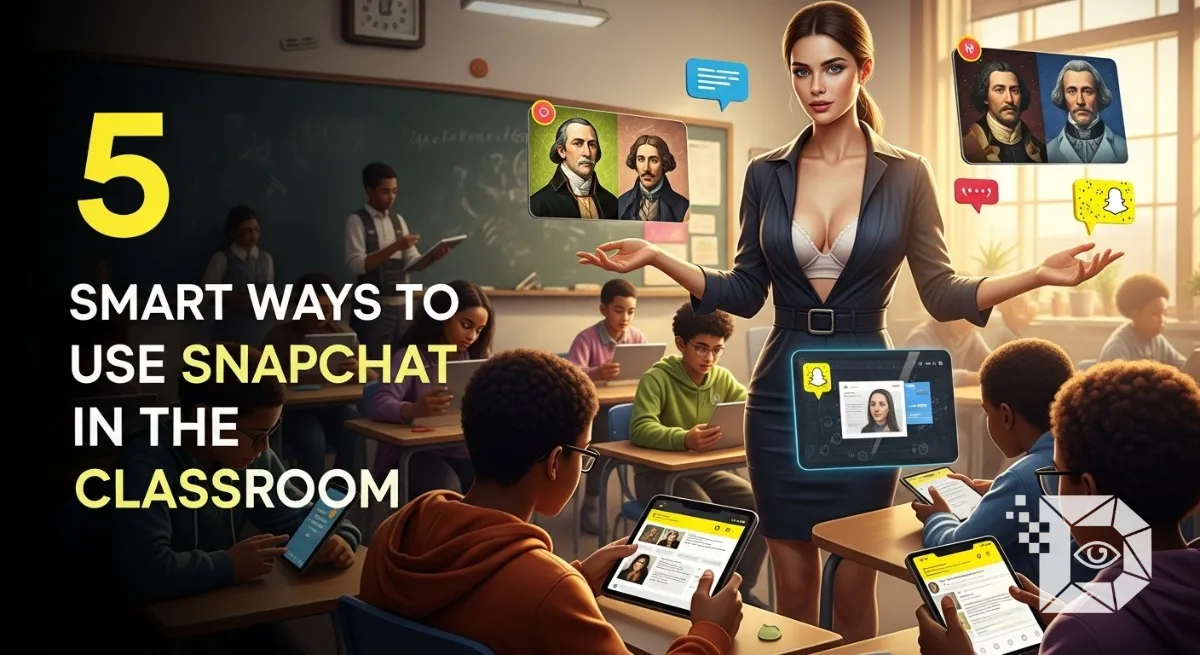
I know what you are thinking. Snapchat? In a classroom? Are you insane? To most educators, that little white ghost logo is the enemy. It is the app that distracts students during lectures. It is the home of vanishing notes, illicit test answers, and drama that spills over into the lunchroom. Your instinct is to ban it. “Phones away. Eyes up.”
But here is the uncomfortable truth: You can ban the device, but you can’t ban the behavior. Students are obsessed with Snapchat not because they love “tech,” but because they love visual communication. They don’t text anymore; they send faces. They don’t write paragraphs; they annotate photos. Instead of fighting a losing war against their attention spans, why not hijack the very tool that is stealing their focus?
If you are brave enough to try it, Snapchat is actually a weirdly powerful educational tool. It has built in augmented reality, annotation tools, and a “short form” constraint that forces students to be concise. Here are five smart, safe, and genuinely effective ways to use Snapchat in your curriculum without losing control of your class.
1. The “Character Takeover” (Literature)
The biggest struggle with Shakespeare or The Great Gatsby is that it feels dead to a 16 year old. The language is archaic. The problems feel dusty. So, modernize the medium. Assign a “Snapchat Takeover” project. Ask your students to retell a chapter of the book from the perspective of a specific character using Snapchat Stories.
-
The Assignment: “You are Hamlet. You just saw your father’s ghost. You have 60 seconds of video to explain how you feel to your followers. Go.”
-
Why it works: It forces them to translate complex Old English emotions into modern vernacular. To make a funny or accurate Snap, they have to understand the source material.
-
Example: A student playing Lady Macbeth using the “black and white” filter to look dramatic, captioning a picture of her hands with “Does this spot look weird to you guys? #Guilty” It turns literary analysis into a performance. And because the videos disappear (or can be saved to Memories), the pressure of “perfection” is gone. They take risks they wouldn’t take in a formal essay.
-
2. The “Math in the Wild” Scavenger Hunt
Math is abstract. That is why kids hate it. They see numbers on a whiteboard and ask, “When will I ever use this?” Snapchat is the answer. The app’s drawing tool is surprisingly robust. It lets you draw lines, angles, and text over real world images. Send your students out on a “Geometry Walk” with their phones.
-
The Mission: Find an obtuse angle in the architecture of the school. Snap a photo of it. Use the “Pen” tool to trace the angle in red. Use the text tool to estimate the degrees.
-
The Result: You get a folder full of photos proving that math exists in doorframes, basketball hoops, and shadows.
-
The Twist: Have them use the “Stickers” feature to solve an equation. You post a Snap of a quadratic equation on the board. They have to Snap a photo of the solution and send it back. It’s faster than a worksheet and way more colorful.
3. The “Micro Vlog” for Foreign Languages
Speaking a new language is terrifying. Standing up in front of 30 peers to conjugate verbs in Spanish is a nightmare for a shy teenager. They freeze up. They mumble. Snapchat removes the audience anxiety. The “disappearing” nature of the app is a feature, not a bug. It lowers the stakes.
-
The Task: “Send me a 10 second Snap of you cooking dinner, narrating what you are doing in French.”
-
Why it helps: They are in their own kitchen. They are comfortable. They can re record the video ten times before they hit send.
-
They practice pronunciation in a low stress environment.
-
You (the teacher) can open it, listen, send a quick text reply with feedback, and move on. It turns “homework” into “content creation.”
-
4. Digital Placemaking with Geofilters (History/Art)
This is for the creative kids. Did you know you can design your own Snapchat Filters? A “Geofilter” is a graphic overlay that only appears when you are in a specific GPS location. This is a goldmine for History and Art classes.
-
The Project: “We are studying the Industrial Revolution. Design a Snapchat filter that represents this city in 1850.”
-
The Skills: They have to research the fashion, the architecture, and the fonts of that era. Then, they have to use graphic design skills to build the overlay.
-
The Payoff: You can actually submit these to Snapchat. Imagine the pride your class would feel if their design became the official filter for the local history museum or the school library. It connects their screen to their physical community.
5. “Fake News” Analysis (Media Literacy)
This might be the most important lesson of all. Snapchat isn’t just a camera; it’s a news source. The “Discover” page is flooded with clickbait, celebrity gossip, and highly edited “news” from publishers like The Daily Mail or BuzzFeed. Don’t ignore it. Put it on the projector. Teach them how to read their own feed.
-
The Lesson: Pick a “News” story from Snapchat Discover. Then, find an article about the same topic from a wire service like AP or Reuters.
-
Compare them:
-
“Look at the headline on Snapchat. Why did they use that emoji? Why is it in all caps?”
-
“What information did the 10 second video leave out that the article included?” You are teaching them to be critical consumers of the content they look at every day. You aren’t saying “Snapchat is bad.” You are saying “Snapchat is a business, and here is how they are selling your attention.”
-
The Safety “Guardrails” (Don’t Get Fired)
Okay, before you download the app, we need to talk about boundaries. Using social media in schools is a legal minefield if you do it wrong. The Golden Rules:
-
Never add students as “Friends” on your personal account. Create a specific “Classroom” account (e.g.,
MrSmithsHistoryClass). -
No DMs. Tell students explicitly: “I do not check DMs for personal chatting. This is for assignment submission only.”
-
The “Projector” Method: You don’t even need to have students add you. You can simply have them save their Snaps to their “Camera Roll” and email them to you, or upload them to Google Classroom. You treat Snapchat as the creation tool (like Photoshop), not the delivery method.
Snapchat speaks the language of your students. It is fast, visual, and informal. You can spend all year trying to drag them back to 1990, or you can meet them in 2026. If you can get past the stigma, you might find that the app they use to send selfies is actually the best way to get them to look at the world around them.